An IB report says some 25,000 preachers of the extreme Wahhabi form of Islam came to India last year as visitors, reports Vicky Nanjappa.

'The alliance between the mullahs of the Wahhabi Al-e Shaikh and the rulers of Saudi Arabia, the Al-e Saud, is like the oppressive nexus between the Christian Church and the monarchy in medieval Europe. It is proving to be a curse for Muslims.'

'It is high time that the 'war on terror' is removed from our diplomatic toolbox.' 'Certainly, our parliamentarians have no role in it,' asserts Ambassador M K Bhadrakumar.
Ustad Abdul Rab Rasul Sayyaf, Afghan president Hamid Karzai's first choice as the speaker of the new Afghan parliament, is at once the perfect bridge the latter needs to reach out extensively in the Islamic world and Pakistan, says former diplomat MK Bhadrakumar, possibly the first and last India to have met Sayyaf in his native village

According to an IB report, preachers of the extreme Wahhabism form of Islam are trying to take over madrasas and masjids, which is a cause of deep concern, says Vicky Nanjappa

The government will have until June 24, 2018, to implement the new decree

The time is over when United States President Barack Obama thought he could afford to make a joke about the ISIS.

Not with standing the Western nations' zeal to wage a war against the group, unless its source of funding is known and curbed, its rampage will likely continue.

Syed Firdaus Ashraf speaks to Haji Syed Salman Chisti, Gaddi Nashi, Dargah Ajmer Sharif, the hereditary custodian of the dargah and the 26th generation descendant of Khwaja Garib Nawaz (as the Pir is known) to understand the meaning and significance of the gesture.
125 Indians on watch-list, Intelligence Bureau agents tell Vicky Nanjappa/Rediff.com

Tarun Vijay visits 20 Durga Puja pandals in five towns in Bangladesh and comes back impressed.

'Once accession to Pakistan appeared unlikely, the British instituted Operations Gulmarg and Datta Khel respectively to foil possible accession to India.'

Armed forces and the police can only ensure that violence is kept under control but for any kind of lasting peace, politicians will have to find an answer to the perception that the Indian State is anti-Islam. Therein lies the biggest challenge to the Modi government, says Colonel Anil A Athale (retired).

Chastened by the Kargil conflict, Pervez Musharraf will be remembered for gradually lowering the profile of terrorism and seeking a realistically negotiated settlement to the issue of Jammu and Kashmir, notes Ambassador G Parthasarathy, who served as India's high commissioner to Pakistan when Musharraf seized power in a coup in October 1999.

A disparate global network of violent fundamentalist Islamic groups threatens India's eastern flank as much as the north and west with a real possibility of these spilling over into our borders, says Shyam Saran.

Even if I completely disagree with what Gulmehar says, I must, as a father, as an Indian, protect her rights and her dignity. Otherwise I am not entitled to be called an Indian, says Tarun Vijay.
India and Indians can ignore Pakistan, but that cannot be said of other nations in the neighbourhood, where New Delhi's 'Neighbourhood First' policy constantly reverberates. Four of the eight SAARC member-nations are Muslim -- Afghanistan and Pakistan, Bangladesh and the Maldives. The rulers decide the nation's India or anti-India policy in the first two, and street-opinion contributes to the same in the latter two, points out N Sathiya Moorthy.

'In India foreign policy is generally handled by the prime minister.' 'One can clearly see the Vajpayee stamp on all this.' 'Only a person with poetic imagination can weave such a complex web,' says Colonel Anil A Athale (retd).

'It should be of concern that some youth in Kashmir have started raising Daesh flags along with those of Pakistan.'

Anti-conversion laws are needed since thrusting the idea of a competitive battlefield of religion onto India's pluralistic traditions can only lead to greater communal conflict, says Sankrant Sanu

'If JNU students are anti-national, why do we send in the police? Why not send in intellectuals like M V Kamath to have a debate and discussion?'
The United States has been successful in engaging with India on tracking money used by radical groups to penetrate into the country, the Barack Obama administration has said as it praised Indian Muslims for demonstrating a great deal of "resilience" against overtures by terrorist groups.
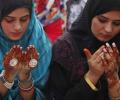
'The osmosis between Hinduism and Islam that really gave birth to the Hindustani or Indo-Islamic civilisation was due to the conversation between Muslim mystics and yogis.'

'Will this communal pendulum, which is swinging towards the extreme of division and violence, ever swing back to its position of the '60s and '70s within my lifetime?' 'Or will my children, and their children, have to continue to suffer the consequences of the country, that we all love, torn apart along communal lines,' asks Najid Hussain in anguish.

'What we are today witnessing is the final act of the Pakistani army trying to retain its turf,' argues Colonel Anil A Athale (retd).

The Al Qaeda, the Islamic State or Daesh, as it is also called, will continue to exploit the fault lines and the many contradictions in the approaches of different countries, says Hardeep Puri.

'We have seen in India that radical ideology has by and large not been successful in taking root.'

'The rise of IS and intolerant Wahabism are the real dangers to Indian democracy and pluralism, not the RSS,' says Rajya Sabha MP Tarun Vijay.

'Nobody is killing you in Kerala because you are Hindu unlike in North India where Muslims have been killed only because they are Muslims and were carrying some meat.'
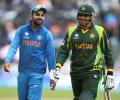
What does Pakistan mean for a young Indian? Devanik Saha attempts an answer.
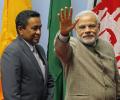
'Now is the time for India, our biggest neighbour and oldest friend, to bring the full array of international policy instruments to bear.'

'Pakistan needs to be constantly at war with somebody, ultimately resulting in it waging war on itself and its own people,' says Shekhar Gupta.


'It was a mission undertaken in darkness in every sense -- literally, because Afghanistan had no electricity at that time; and, metaphorically because Delhi historically dealt only with the Pashtuns of Afghanistan and the foreign ministry's vast archives had nothing to offer on the culture and politics of the northern tribes in the Hindu Kush.'

'The Pakistan government, we were told, has a plan to renovate several Hindu temples and Buddhist sites, which over the years have fallen into disrepair. The aim is to create a pilgrimage circuit to attract visitors from all over the subcontinent.'
